



 Qualifies Towards Free Ground Economy Shipping (CONUS Only) For Most Orders Of $149 Or More
Condition:
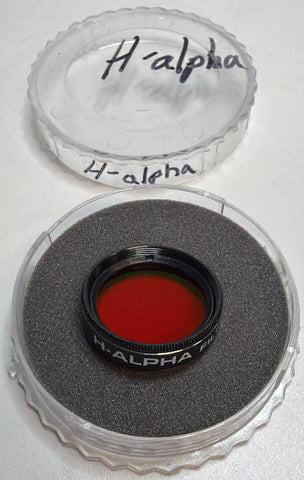
This is a used Orion Hydrogen-Alpha filter. It is in excellent condition, completely clean and unmarked. It comes in its original jewel case.
Any dust you may see in the photos is removable - it seems that these filters develop an electrostatic charge such that the dust in the air is just attracted to the filter.
This is NOT for use on the sun! This does not have the blocking capacity to reduce the amount of light getting to your eyes. Using this on the sun WILL damage your eyes, so don't do it!
Description:
The H-alpha filter passes light at 656nm wavelength. If you want high contrast astroimaging, then this Hα filter will deliver an excellent performance.
Enhance your telescope's capabilities with a Hydrogen Alpha (H-Alpha) filter. These filters are designed to capture the deep red wavelengths emitted by hydrogen atoms, making them essential for imaging emission nebulae and other celestial wonders. Our H-Alpha filters provide unparalleled detail and contrast, allowing you to explore the rich, intricate structures of the night sky. Whether you're capturing the famous Orion Nebula or other deep-sky objects, H-Alpha filters will enhance your results, making the unseen visible and the faint spectacular. Experience the hidden beauty of the universe with an H-Alpha filter.
Get Great Nebula Images Under City Lights or a Full Moon with the Orion Hydrogen-Alpha Filter!
Imagine capturing brilliant, high-contrast images of nebulas in full moonlight or in the thick of downtown light pollution. Bring it on, because you can do just that with Orion\'s H-alpha Astrophotography filter.
Designed exclusively for deep-sky astrophotography of emission nebulas, this filter transmits H-alpha light at the hydrogen-alpha line of 656.3nm. It blocks out all other light, including artificial light pollution and moonlight. It also blocks infrared (IR) light. The result is a dramatic boost in contrast, revealing subtle nebular details that are usually washed out by contrast-killing broadband light. Stars come out tight and sharp.
Note: This filter should NOT be used for solar observation.