



 Qualifies for Free Ground Economy Shipping (CONUS Only)
A 90mm smart telescope built for Hubble-palette color on emission nebulae
Why we like the Draco SHO Edition:
- Three narrowband colors, done for you: it has two built-in dual-band filters, H-alpha + OIII and SII + OIII, so it can capture all three emission lines and combine them into a Hubble-palette (SHO) image without a mono camera or filter wheel.
- A real jump in aperture: 90mm at f/3.8 collects about 3.2× the light of a 50mm smart telescope and 9× that of a 30mm one, which shows in faint nebula detail.
- Long exposures without a wedge: the camera sensor physically rotates to cancel field rotation, and a built-in guide camera corrects tracking, so it can take single exposures up to 300 seconds in alt-az mode. We don't know of another smart telescope that does both.
- Worth knowing: Draco is brand new (launched September 2026), so independent owner reviews are still few. If you mostly image galaxies and star clusters, the Standard Edition costs $200 less.
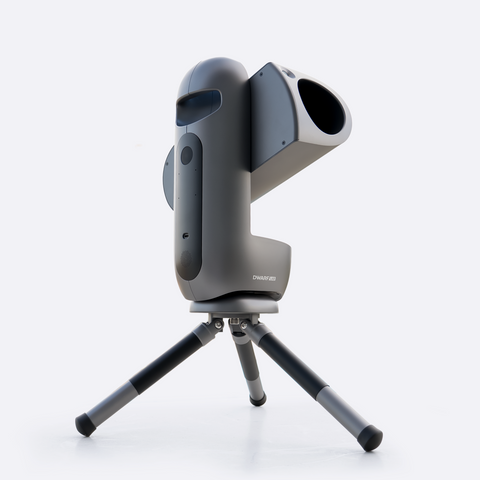
The DwarfLab Draco SHO Edition is an all-in-one smart telescope for imagers who want more aperture and more control than a pocket-sized smart scope can give. It finds, tracks, guides, focuses and stacks on its own and shows the image building up on your phone. The SHO Edition adds a sulfur-II + oxygen-III filter to the Standard Edition's filters, which is what you need for false-color "Hubble palette" pictures of emission nebulae. It's for beginners who want room to grow and for experienced imagers who want a simpler second rig, with Pro Mode and FITS/TIFF files when you want to process images yourself.
Key specs: 90mm f/3.8 telescope, 340mm focal length · 1/1.3" 50MP telephoto sensor with cooling · built-in guide camera · rotating sensor for field derotation · single exposures up to 300 s · H-alpha/OIII and SII/OIII dual-band filters · 10,000mAh battery (about 5 hours) · 5.5kg (12.1lb)

What you can capture
- Emission nebulae in SHO color: the Eagle Nebula and Pillars of Creation, the Lagoon, Trifid, Heart, Soul, Rosette, Crescent and Veil Nebulae. These are the targets the SHO filter is made for.
- Nebulae from the city: narrowband filters block most light pollution and moonlight, so these targets still work from a suburban backyard.
- Galaxies and clusters: the Andromeda, Whirlpool and Pinwheel Galaxies, and the Hercules Cluster, using the broadband astro filter from darker skies.
- The Milky Way and landscapes: the wide-angle camera covers about 86° and can shoot at the same time as the telephoto.
- The Moon and Sun: lunar craters, and sunspots with the included external solar filter.
How it works
Set Draco on its tripod, open the DWARFLAB app and pick a target. It aligns on the stars, slews to the object, autofocuses and starts stacking. The built-in guide camera makes small tracking corrections, and the sensor turns slowly to match the sky's rotation, so stars stay round in long exposures. The sensor is cooled to cut noise, and that warmth is reused to keep dew off the lens.
For even longer total exposures, Draco also has an equatorial (EQ) mode, and you can control it remotely and leave it running.

Using Draco in Colorado
- Front Range light pollution: the narrowband filters make the SHO Edition a good fit for Denver-area backyards. Save galaxies for a darker site.
- Cold and dusty sites: DwarfLab rates Draco from -20°C to 45°C (-4°F to 113°F) and IP56 for dust and splashing water. Charge it indoors, and bring a USB-C power bank on winter nights.
- Wind: at 5.5kg it's steadier than smaller smart scopes, but set it low and out of gusts for the sharpest long exposures.
What to add for the best results
- Precision Tripod Leveler: fast, accurate leveling on uneven ground for a quicker alignment.
- A USB-C power bank: extends the roughly 5-hour battery for all-night sessions.
Draco SHO vs. Draco Standard vs. DWARF 3
| Draco SHO Edition | Draco Standard | DWARF 3 | |
|---|---|---|---|
| Aperture | 90mm (f/3.8) | 90mm (f/3.8) | 35mm (f/4.3) |
| Narrowband filters | H-alpha + OIII and SII + OIII | H-alpha + OIII | H-alpha + OIII |
| Solar filter | External, included | Built in | Included |
| Guiding and field derotation | Yes | Yes | No |
| Weight | 5.5kg (12.1lb) | 5.5kg (12.1lb) | 1.3kg (2.9lb) |
| Best for | Emission nebulae in Hubble-palette color | All-around deep sky, including galaxies | Travel and a lower price |
Choose the SHO Edition if emission nebulae are your main targets. Choose the Standard Edition if you'd rather have a built-in solar filter and the lower price. See all DWARFLAB smart telescopes.
What's in the box
- DwarfLab Draco SHO Edition smart telescope
- Tabletop tripod (aluminum, 3/8"-16 thread)
- External ND solar filter
- USB-C cable
- Cleaning cloth

Draco SHO Edition FAQ
What is the Hubble palette (SHO)?
It's a way of coloring nebula images from three narrow emission lines: sulfur-II (S), hydrogen-alpha (H) and oxygen-III (O). It's the look of the famous Hubble images like the Pillars of Creation. The SHO Edition captures all three lines with its two dual-band filters and combines them for you.
Is Draco good for beginners?
Yes. Alignment, focusing, guiding and stacking are automatic. It's a bigger and more expensive instrument than a Seestar or DWARF 3, so it suits beginners who already know they want to go further with astrophotography.
SHO Edition or Standard Edition?
Both have the same telescope, cameras and guiding. The SHO Edition adds the SII + OIII filter for Hubble-palette nebula images and uses an external solar filter. The Standard Edition has a built-in solar filter and costs less. If you mostly image galaxies, the Standard is enough.
Draco or DWARF 3?
The DWARF 3 is much smaller and lighter, and great for travel. Draco's 90mm aperture gathers about 6.6× more light, and its guiding and rotating sensor allow far longer exposures, so it shows much more faint detail.
Can I see Saturn and Jupiter?
You can photograph them, and the Moon looks excellent, but at 340mm focal length planets are small. Draco is built for deep-sky objects.
Can I look through it with an eyepiece?
No. Like other smart telescopes it's camera-based, and you view images on your phone or tablet.
Can I photograph the Sun?
Yes, with the included external solar filter attached and the app's solar workflow. Never point Draco at the Sun without the filter in place.
How long does the battery last?
About 5 hours on the 10,000mAh battery (DwarfLab's figure). It charges over USB-C.
Specifications
| Optics | |
|---|---|
| Aperture | 90mm |
| Focal length | 340mm (f/3.8) |
| Telephoto field of view | About 2.06° diagonal |
| Wide-angle field of view | About 86° diagonal |
| Cameras and filters | |
| Telephoto sensor | 1/1.3", 50MP, cooled |
| Wide-angle sensor | 50MP |
| Guide camera | Built in, monochrome |
| Exposure | 1/10,000 s to 300 s per frame |
| Filters | Astro (broadband), H-alpha + OIII dual-band, SII + OIII dual-band; external ND solar filter |
| File formats | JPG, PNG, TIFF, FITS |
| Tracking | |
| Modes | Alt-azimuth with physical sensor rotation; equatorial (EQ) mode |
| Guiding | Built-in guide scope with real-time correction |
| Power and physical | |
| Battery | 10,000mAh, about 5 hours |
| Storage | 128GB |
| Weather rating | IP56 |
| Operating temperature | -20°C to 45°C (-4°F to 113°F) |
| Weight | 5.5kg (12.1lb) body; tripod about 480g |
| Dimensions | About 386 × 196 × 133mm (15.2 × 7.7 × 5.2 in) |
| Warranty | 2 years (DwarfLab) |
| Model | Draco SHO Edition |