



Yes, our inventory is accurate!
 Qualifies for Free Ground Economy Shipping (CONUS Only)
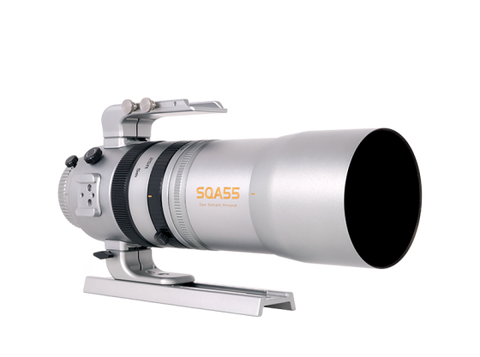
A 2kg full-frame astrograph that also works as a 264mm camera lens
Why we like the Askar SQA55:
- Huge, flat fields: the five-element Petzval design (one SD and one ED element) covers a full-frame sensor and frames 5.1° × 3.4° on an APS-C camera, enough for the whole Veil Nebula, the North America and Pelican Nebulae or the Rho Ophiuchi clouds in one shot.
- Tight stars to the corners: in Askar's design data the star image is under 2.5µm RMS radius in the center and under 4µm at the corner of a full-frame sensor, with about 90% illumination at the edge.
- A camera lens too: a 14-blade iris from f/4.8 to f/22, a focus scale in feet and meters, a 5m (16ft) close focus distance and an M67 front filter thread make it a sharp 264mm telephoto for landscapes and wildlife.
- Worth knowing: with 55mm of aperture, faint targets need long total exposure time, and at about 2.9″ per pixel on an APS-C camera small galaxies stay small. It's made for cameras, not eyepieces, and the sensor needs to sit 50 to 60mm behind the rear adapter.
The Askar SQA55 is a 55mm f/4.8 quintuplet air-spaced Petzval astrograph with a 44mm image circle and a self-flattened design, so there's no flattener to buy and no exact spacing to hit within its 50–60mm range. It's built like a photo lens: a dual-speed focuser with a coarse distance scale and a ±1mm fine adjustment, an independent 360° rotator, a quick-release dew shield, four quick-release accessory bases, a quick-release foot with a 200mm Vixen-style plate, and an M48 rear adapter with a built-in 2" filter thread. It weighs 1.84kg (4.1lb) as a bare tube and comes in a waterproof hard case, so it's an easy telescope to fly with or keep in the car.
Key specs: 55mm aperture · 264mm focal length · f/4.8 (iris to f/22) · quintuplet Petzval APO with 1 SD and 1 ED element · 44mm image circle · 50–60mm back focus from the M48 adapter · 2.18kg (4.8lb) with handle and dovetail plate · waterproof hard case included

What you can image
- Big nebula fields: the whole Veil Nebula complex, the North America and Pelican Nebulae, the California Nebula, the Heart and Soul Nebulae, and the Lagoon and Trifid Nebulae (M8 and M20) together.
- Winter and summer Milky Way: Orion's Belt and Sword from the Horsehead to the Orion Nebula, the Jellyfish Nebula with the Monkey Head (IC 443 and NGC 2174), the Rho Ophiuchi cloud complex and the Cygnus region around the Crescent Nebula.
- Galaxies with room around them: the entire Andromeda Galaxy with M32 and M110, and the Triangulum Galaxy.
- Daytime: landscapes, wildlife and the Moon with a mirrorless or DSLR camera, using the iris and focus scale like a regular telephoto lens.
Fields of view at 264mm: 7.80° × 5.21° with a full-frame sensor, 5.10° × 3.41° with an APS-C camera such as the ASI2600MC Pro (2.94″ per pixel), and 2.45° × 2.45° with the ASI533MC Pro.
How it works
Connecting a camera: the rear M48 × 0.75 adapter has a built-in 2" filter thread. Place the sensor 50 to 60mm behind it; 55mm is the recommended spacing. With a ZWO cooled camera, the 21mm and 16.5mm M48 extension tubes that come with the camera plus its 17.5mm back focus make exactly 55mm. Mirrorless cameras and DSLRs connect with an M48 T-ring.
Focusing: turn the coarse focus ring to the infinity mark, then refine with the fine ring, which has ±1mm of travel, a center mark and its own lock. The coarse ring has MXL timing teeth, so an electronic focuser drives it with a timing belt. Askar shows the ZWO EAF, QHYCCD Q-Focuser, ToupTek, Pegasus FocusCube 3, iOptron iEAF and Astroasis Oasis all fitted this way.
Framing: the tube rotates in its mount for daytime shooting, and a separate high-precision 360° rotator with a scale turns just the camera for astrophotography. Both have their own locks.

What to add for the best results
- A mount (required for astrophotography): the Sky-Watcher Star Adventurer GTi is a compact GoTo mount for a light setup like this, and the ZWO AM5N carries it with plenty of room for a bigger telescope later.
- A camera: the ZWO ASI2600MC Air with built-in ASIAIR and guider keeps the whole kit small; the ASI2600MC Pro, ASI2600MM Pro or full-frame ASI6200MC Pro pair with an ASIAIR Plus.
- A camera adapter for daytime and DSLR imaging: an M48 T-ring such as the Sony E, Canon EOS R or Nikon Z version.
- Autofocus: the Askar SQA55 AF Kit (belts, pulleys and a short bracket made for this telescope) with a ZWO EAFN or EAF Pro.
- A handle with a finder base: the SQA55 quick-release handle bar clips onto the tube's quick-release bases and holds a guide scope such as the Askar 32mm f/4.
- Filters: a 2" Askar Colour Magic C1 (Hα + OIII) threads into the rear adapter for nebulae under city skies.
SQA55 vs. other small Askar astrographs
| FMA180 Pro | SQA55 | SQA60 Pro | SQA70 | |
|---|---|---|---|---|
| Aperture / focal length | 40mm / 180mm, f/4.5 | 55mm / 264mm, f/4.8 | 60mm / 276mm, f/4.6 | 70mm / 336mm, f/4.8 |
| Optics | Sextuplet APO, 2 ED | Quintuplet Petzval, 1 SD + 1 ED | Sextuplet Petzval, 2 SD | Quintuplet Petzval, 2 ED |
| Field, APS-C sensor | 7.47° × 4.99° | 5.10° × 3.41° | 4.88° × 3.26° | 4.01° × 2.68° |
| Back focus range | 55mm | 50–60mm | 41–66mm | 37–68mm |
| Weight | 0.8kg (1.8lb) with ring and plate | 2.18kg (4.8lb) with handle and plate | 3.54kg (7.8lb) with ring and plate | 3.5kg (7.7lb) with ring and plate |
| Iris and photo-lens focus scale | No | Yes, f/4.8–f/22 | No | No |
| Best for | The lightest wide-field kit, or a guide scope | Wide fields plus daytime photography | The best-corrected small field | More focal length for medium nebulae |
All four cover a 44mm full-frame image circle. See all Askar telescopes.
What's in the box
- Askar SQA55 optical tube with quick-release dew shield, foot and 200mm Vixen-style dovetail plate
- M48 rear adapter with built-in 2" filter thread
- Military-grade waterproof two-layer hard case with EVA foam interior and room for accessories

A mount, camera, T-ring, electronic focuser, AF kit and handle bar are sold separately.
Askar SQA55 FAQ
Is the SQA55 good for beginners?
Yes. A 264mm focal length is very forgiving of tracking errors, it's light enough for a small GoTo mount, and the self-flattened design removes the usual spacing headaches. You'll still need a mount, a camera and some time learning to process images.
SQA55 or SQA60 Pro?
The SQA60 Pro has a six-element design with two SD elements, a slightly faster f/4.6 and a wider 41–66mm back-focus range, but weighs about 1.4kg more. The SQA55 is lighter and adds the iris and focus scale for daytime photography.
SQA55 or FMA180 Pro?
The FMA180 Pro is smaller, lighter and wider (180mm), and can also serve as a guide scope. The SQA55 collects almost twice the light (55mm vs. 40mm) for faster imaging and finer detail.
Can I use it for visual observing?
Askar designs the SQA55 for astrophotography and daytime photography with cameras. For an Askar you can also use with eyepieces, look at the 71F or 91F.
Which camera works best?
An APS-C camera such as the ASI2600MC Pro or Air gives a 5.1° × 3.4° field at about 2.9″ per pixel, a good balance for this telescope. A full-frame camera uses the whole 44mm image circle for nearly 8° of sky.
Specifications
| Optics | |
|---|---|
| Optical design | Quintuplet air-spaced Petzval APO, 1 SD and 1 ED element; self-flattened |
| Aperture | 55mm |
| Focal length / ratio | 264mm / f/4.8 |
| Aperture iris | 14 blades, f/4.8 to f/22 |
| Image circle | 44mm (full frame) |
| Spot size (design) | Under 2.5µm RMS radius on axis; under 4µm at the full-frame corner |
| Relative illumination | About 90% at the edge of the full frame |
| Closest focus | 5m (16ft) |
| Mechanical | |
| Focuser | Manual dual-speed: coarse ring with feet/meter scale and MXL timing teeth; fine ring with ±1mm travel; separate locks |
| Rotation | Rotating tube mount plus independent 360° rotator with scale |
| Rear connection | M59 × 0.75 to M48 × 0.75 adapter with built-in 2" filter thread; 50–60mm back focus, 55mm recommended |
| Front filter thread | M67 |
| Mounting | Quick-release foot with 1/4" and 3/8" holes; 200mm Vixen-style dovetail plate; four quick-release accessory bases |
| Physical | |
| Length | 316mm with dew shield; 244mm without |
| Weight | 1.84kg (4.1lb) tube; 2.18kg (4.8lb) with handle and dovetail plate |
| Included case | Military-grade waterproof hard case |
| Model / SKU | Askar SQA55 / SQA55 |