



Yes, our inventory is accurate!
 Qualifies for Free Ground Economy Shipping (CONUS Only)
More aperture and reach than a RedCat 51, with the same no-flattener simplicity
Why we like the RedCat 61:
- A step up in reach: 300mm of focal length frames nebulae and galaxies a little closer than the 250mm RedCat 51, and the 61mm lens collects about 40% more light.
- Full frame without a flattener: the 4-element Petzval design has a 46mm image circle, so it covers full-frame, APS-C and smaller sensors with nothing extra to buy or space.
- Built for heavy cameras: the WIFD focuser moves the optics inside the tube, so a cooled camera and filter wheel never hang off a drawtube, and its 42mm of travel reaches focus with a wide range of setups.
- Worth knowing: at 3.39kg (7.47lb) with ring, handle and dovetail, it's heavier than the RedCat 51. A strain-wave mount is a better match than a camera star tracker once you add a cooled camera.
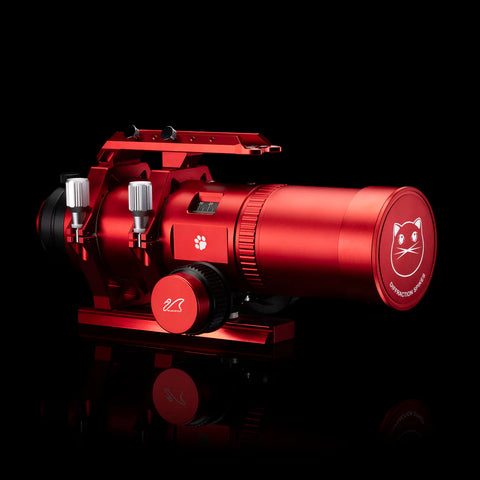
The William Optics RedCat 61 WIFD f/4.9 is a 61mm, 300mm focal length Petzval apochromatic astrograph for wide-field astrophotography. Its 4-element optics produce a flat, color-corrected field across a 46mm image circle with no separate flattener. William Optics' patented WIFD focuser is built into the center of the tube, with a rack-and-pinion knob and a focus-position window on top, and the included rotator and tilt adjuster finish the imaging train. The tube is 365mm long and the scope weighs 2.47kg (5.45lb) on its own.
Key specs: 61mm aperture · 300mm focal length · f/4.9 · 4-element Petzval APO · 46mm image circle (full frame) · no flattener needed · WIFD rack-and-pinion focuser, 42mm travel, EAF compatible · 3.39kg (7.47lb) total

What you can image
| Camera sensor | Field of view | Image scale |
|---|---|---|
| Full frame (36 × 24mm) | 6.9° × 4.6° | 2.6"/pixel (3.76µm pixels) |
| APS-C (23.5 × 15.7mm), e.g. ZWO ASI2600MC Pro | 4.5° × 3.0° | 2.6"/pixel (3.76µm pixels) |
| 1" square (11.3 × 11.3mm), e.g. ZWO ASI533MC Pro | 2.2° × 2.2° | 2.6"/pixel (3.76µm pixels) |
- Large nebulae: the North America and Pelican Nebulae together, the whole Veil Nebula complex, the Heart Nebula and the California Nebula fit an APS-C frame.
- Galaxies: the Andromeda Galaxy with room around it, the Triangulum Galaxy, and the M81 and M82 pair.
- Winter favorites: the Rosette Nebula, the Pleiades with their dust, and the Horsehead and Flame Nebulae.
- Full-frame vistas: on a full-frame sensor, Orion's Belt and Sword region or the Rho Ophiuchi clouds.
How it works
Back focus: the RedCat 61 needs no flattener. Set your camera sensor 55mm from the camera adapter, as shown on William Optics' drawing. The rotator ends in an M54 × 0.75 thread and the included adapter steps it to M48 × 0.75 for wide T-rings and astronomy camera spacers.
Focusing: the WIFD rack-and-pinion focuser slides the internal optics, so nothing moves outside the tube. A scale window shows the focus position, and the focus knob has a built-in thermometer. The knob removes so an electronic focuser can take over.
Framing: turn the camera with the degree-marked rotator and lock it with the thumbscrew, and correct sensor tilt with the tilt adjuster. The lens cap doubles as a Bahtinov focusing mask.

What to add for the best results
- A mount (required): a strain-wave mount like the ZWO AM3N with TC40 tripod, the ZWO AM5N or the Sky-Watcher Wave 100i with steel tripod. The Star Adventurer GTi can carry it with a light DSLR or mirrorless camera, close to its limit.
- A camera (required): a full-frame or APS-C camera makes the most of the 46mm image circle, such as the ZWO ASI2600MC Pro, the ASI2600MM Pro or the ASI2600MC Air with built-in ASIAIR.
- A T-ring for DSLR or mirrorless cameras: William Optics wide M48 T-mounts for Canon EF, Canon RF, Nikon F, Nikon Z and Sony E.
- Autofocus: a ZWO EAFN or EAF Pro, with the K-Astec EAF bracket with clutch made for WIFD focusers.
- Filters: a ZWO M54 2" filter drawer lets you swap 2" filters without removing the camera. It's 20mm thick, so it counts toward the 55mm back focus.
- Guiding and control: a UniGuide 32 guide scope on the handle bar and an ASIAIR Plus to run the whole setup. For a longer dovetail, the WO DSD 210 dual-sided plate fits both Vixen and Arca-Swiss style clamps.
RedCat 61 vs. RedCat 51 III vs. MiniCat 51
| RedCat 61 | RedCat 51 III | MiniCat 51 | |
|---|---|---|---|
| Aperture | 61mm | 51mm | 51mm |
| Focal length | 300mm (f/4.9) | 250mm (f/4.9) | 178mm (f/3.5) |
| Lens elements | 4 | 4 | 6 |
| Image circle | 46mm (full frame) | 48mm (full frame) | 43.2mm (APS-C recommended) |
| Focuser travel | 42mm | 23mm | 28mm |
| Total weight | 3.39kg (7.47lb) | 2.38kg (5.25lb) | 2.29kg (5.05lb) |
| Best for | A little more aperture and reach | A light full-frame astrograph | The widest, fastest fields |
See all William Optics Cat astrographs.
What's in the box

- William Optics RedCat 61 WIFD f/4.9 astrograph with tilt adjuster and rotator
- Bahtinov mask cap for focusing
- M48 camera adapter
- Mounting rings and handle bar
- Dual-sided dovetail plate
- Soft carry case
- Allen key set
The mount, camera, T-ring and filters are sold separately.
William Optics RedCat 61 FAQ
Is the RedCat 61 good for beginners?
Yes. There's no flattener to space, the 300mm focal length is forgiving to guide, and the cap doubles as a focusing mask. Most beginners pair it with a strain-wave mount and an APS-C camera.
RedCat 61 or RedCat 51?
The RedCat 61 has 61mm of aperture and 300mm of focal length for a slightly closer view and more light, plus a longer-travel focuser for heavier imaging trains. The RedCat 51 III is about 1kg lighter and a little wider, which makes it the easier choice for a star tracker or air travel.
Is the RedCat 61 the same as the Cat 61 WIFD?
Yes. William Optics now lists this telescope as the Cat 61 WIFD. The red version is the RedCat 61.
Do I need a field flattener?
No. The Petzval design has the flattening built in. Set your camera sensor 55mm behind the camera adapter using the right T-ring or spacers.
Can I use it for visual observing?
It's designed as an astrograph for cameras, and William Optics doesn't list a visual configuration for it.
What mount do I need?
Plan for about 3.4kg (7.5lb) for the telescope with ring, handle and dovetail, plus your camera, guide scope and controller. A ZWO AM3N or Wave 100i handles this comfortably.
Can I add an electronic focuser?
Yes. The focus knob removes so a ZWO EAFN can drive the WIFD focuser. Installation steps are in the William Optics online manual.
Specifications
| Optics | |
|---|---|
| Optical design | 4-element Petzval apochromat |
| Aperture | 61mm |
| Focal length | 300mm |
| Focal ratio | f/4.9 |
| Image circle | 46mm |
| Camera formats | Full frame, APS-C and Micro Four Thirds |
| Field flattener | None required |
| Dawes limit | 1.9 arcseconds |
| Focuser and imaging train | |
| Focuser | WIFD internal rack and pinion, EAF compatible, thermometer in the focus knob |
| Focuser travel | 0–42mm (scale to 50mm) |
| Back focus | 55mm |
| Camera threads | M54 × 0.75 and M48 × 0.75 |
| Included adapters | Tilt adjuster, rotator, M54 to M48 adapter |
| Physical | |
| Tube length | 365mm |
| OTA weight | 2.47kg (5.45lb) |
| Total weight with rings, handle and dovetail | 3.39kg (7.47lb) |
| Color | Red |
| Model / SKU | T-C-61RD |