



 Qualifies for Free Ground Economy Shipping (CONUS Only)
A complete mono imaging rig for LRGB and Hubble-palette narrowband
Why we like the RedCat 51 Mono Kit:
- Every filter slot filled: luminance, red, green and blue for galaxies and clusters, plus hydrogen-alpha, OIII and SII for narrowband. All seven stay in the wheel, so switching from a galaxy to a nebula is a tap in the app.
- Narrowband beats city skies and the Moon: a mono camera with narrowband filters records emission nebulae from a Denver-area backyard, even with a bright Moon up.
- An easy telescope to image with: the RedCat 51 needs no flattener, its 250mm focal length is forgiving of small tracking errors, and the internal WIFD focuser holds focus through long filter sequences, with the EAFN refocusing after filter changes.
- Worth knowing: mono imaging takes more time per target and more processing than a color camera, since each filter is captured and combined separately. It's best for imagers who already have a few nights of experience, or who want to grow into it. The included 30-minute support session helps you get started.
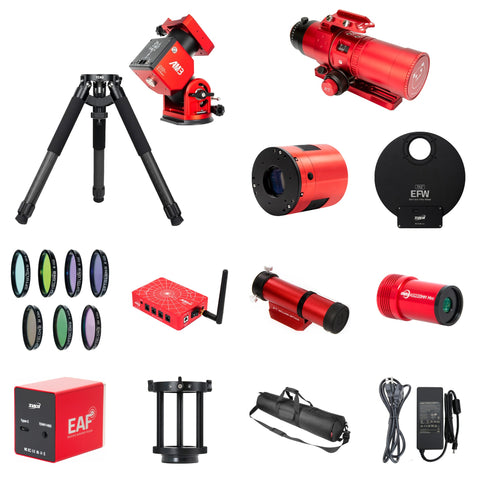
The RedCat 51 Mono Astrophotography Kit pairs the William Optics RedCat 51 III WIFD astrograph with the ZWO ASI2600MM Pro cooled monochrome camera, a ZWO 7-position 2" filter wheel loaded with Optolong LRGB and SHO narrowband filters, and your choice of ZWO harmonic mount, the compact AM3N or the larger AM5N, each on a TC40 carbon fiber tripod with a pier extension. A UniGuide 32 guide scope with an ASI220MM Mini handles guiding, an EAFN handles focus, and the ASIAIR Plus runs the whole sequence from your phone or tablet. The camera and telescope frame 5.4° × 3.6° of sky, wide enough for the largest nebula complexes in one frame.
Key specs: RedCat 51 III: 51mm aperture, 250mm focal length, f/4.9, 4-element Petzval, 48mm image circle · ASI2600MM Pro: 26MP APS-C IMX571 mono, 3.76µm pixels, 91% peak QE, 16-bit, cooled 30–35°C below ambient · 5.4° × 3.6° field at 3.1″/pixel · ZWO EFW 7x2" with 7 Optolong 2" filters (L, R, G, B, Hα, OIII, SII) · AM3N: 8kg (17.6lb) payload without counterweight; AM5N: 15kg (33lb) · ASIAIR Plus, UniGuide 32 guiding, EAFN autofocus

What you can image
- Hubble-palette nebulae: the Heart and Soul, the North America and Pelican, the Veil complex, the Rosette and the Elephant's Trunk region in IC 1396, mapped in sulfur, hydrogen and oxygen.
- Faint structure from the suburbs: hydrogen-alpha alone pulls out the dark lanes of the Eagle and the shells around the Crescent Nebula from a Front Range backyard.
- Natural-color galaxies and clusters in LRGB: the Andromeda Galaxy with M32 and M110, the Triangulum Galaxy, the Pleiades with their dust and the Double Cluster, best from a darker site.
- Mixed images: add hydrogen-alpha to an LRGB galaxy or nebula to bring out its red star-forming regions.
At 3.1 arcseconds per pixel, the image scale is easy to guide and forgiving of average seeing.
How it works
Mount and tripod: set the pier extension on the TC40 tripod and the mount on top. Neither mount needs a counterweight for this kit, so there's nothing to balance. The pier extension lifts the mount so the camera and filter wheel clear the tripod legs when the telescope points high.
Telescope, filter wheel and camera: the RedCat's dual Vixen and Arca-Swiss plate fits the mount's saddle. The filter wheel (20mm thick) sits between the RedCat and the ASI2600MM Pro, and the camera's spacers make up the rest of the 55mm back focus the RedCat needs (±3mm). We're happy to help you set up the spacing. The filter wheel takes power and data over USB from the camera's built-in hub. The UniGuide 32 slides onto the base on the RedCat's handle with the ASI220MM Mini in it, and the EAFN attaches to the WIFD focuser in place of its removable knob.
Control and power: the camera, guide camera and focuser plug into the ASIAIR Plus, which connects to the mount and runs polar alignment, plate solving, GoTo, autofocus, guiding and multi-filter sequences from the ASIAIR app. Plan a night as "60 frames of hydrogen-alpha, then OIII, then SII" and the ASIAIR changes filters and refocuses on its own. The ZWO 12V 10A adapter powers the setup from an outlet.
Using it in Colorado: both mounts are rated down to -20°C (-4°F). Narrowband lets you image on Moon-bright nights that would wash out a color camera, which adds a lot of usable nights each month. Dark sites rarely have an outlet, so plan on a 12V battery there.
What to add for the best results
- Field power: a 12V battery such as the Celestron PowerTank Lithium Pro for dark sites without an outlet.
- Processing software (required): combining filter channels takes a computer with software such as Siril (free) or PixInsight.
- A phone or tablet with the free ASIAIR app (iOS or Android).
- A dew heater strap for humid or frosty nights.
Which RedCat 51 kit is right for you?
| RedCat 51 Mono Kit | RedCat 51 Color Kit | UltraCat 76 + AM5N Traveler Kit | |
|---|---|---|---|
| Telescope | RedCat 51 III, 250mm f/4.9 | RedCat 51 III, 250mm f/4.9 | UltraCat 76, 365mm f/4.8 |
| Camera | ASI2600MM Pro (mono, 91% QE) | ASI2600MC Pro (color, 80% QE) | ASI2600MC Air (color, built-in ASIAIR and guider) |
| Field of view | 5.4° × 3.6° | 5.4° × 3.6° | 3.7° × 2.5° |
| Filters | 7-position wheel with LRGB and SHO narrowband | L-eNhance tri-band in an M54 drawer | None included |
| Guiding | UniGuide 32 + ASI220MM Mini | UniGuide 32 + ASI220MM Mini | Built into the camera |
| Mount | AM3N or AM5N | AM3N or AM5N | AM5N |
| Best for | Narrowband from the city and the most detail per hour | Color images in one shot, with the simplest workflow | A closer view of galaxies with the fewest cables |
Read more about each piece on the RedCat 51 III, ASI2600MM Pro, EFW 7x2", AM5N and ASIAIR Plus pages, or see all astro imaging kits.
What's in the box
- William Optics RedCat 51 III WIFD with rotator and tilt adjuster, Bahtinov mask cap, M48 camera adapter, mounting ring and handle, dual Vixen/Arca-Swiss plate, soft case and Allen keys
- ZWO ASI2600MM Pro (2025) cooled monochrome camera with its spacers and cables
- ZWO 7-position 2" electronic filter wheel (2025)
- Optolong 2" LRGB + SHO filter set: luminance, red, green, blue, hydrogen-alpha, OIII and SII
- Your choice of mount, each with a ZWO TC40 carbon fiber tripod: the ZWO AM3N with the PE160 pier extension, or the ZWO AM5N with the PE200 pier extension
- Tripod case for the TC40 with pier extension
- ZWO ASIAIR Plus 256GB
- William Optics UniGuide 32 guide scope and ZWO ASI220MM Mini guide camera
- ZWO EAFN electronic focuser
- ZWO 12V 10A AC adapter (US plug)
- One 30-minute tech support session with the Mile High Astronomy team

A 12V field battery, dew heater and processing software are sold separately.
RedCat 51 Mono Kit FAQ
Is a mono kit too much for a beginner?
It's more to learn than a color camera, mostly in processing. If you've never imaged before, the RedCat 51 Color Kit is the gentler start. If you live under light-polluted skies and want the most from narrowband, the mono kit is worth the extra learning, and the ASIAIR automates the filter changes for you.
What is the SHO or Hubble palette?
It maps sulfur (SII), hydrogen-alpha and oxygen (OIII) light to red, green and blue, the approach used for many Hubble Space Telescope images. It shows structure inside emission nebulae that a normal color image can't separate.
AM3N or AM5N?
Both carry this kit without a counterweight. The AM3N (8kg / 17.6lb payload, 4.1kg head) is lighter to carry and costs less. The AM5N (15kg / 33lb payload, 5.5kg head) leaves room for an 80–100mm refractor later.
Do I need a computer?
Not to capture images; the ASIAIR Plus runs everything from a phone or tablet. You do need a computer to stack and combine the filter channels.
Why does it include a guide scope?
Harmonic mounts carry a lot without counterweights, but they have small periodic tracking errors that show up in long narrowband exposures. The UniGuide 32 and ASI220MM Mini let the ASIAIR correct them automatically.
Can I use the RedCat 51 for visual observing?
No. The RedCat 51 is an astrograph made for cameras, and standard diagonals and eyepieces won't reach focus.
Specifications
| Telescope: William Optics RedCat 51 III WIFD | |
|---|---|
| Optical design | 4-element Petzval apochromat, FPL-53 and FPL-51 ED glass |
| Aperture / focal length | 51mm / 250mm (f/4.9) |
| Image circle | 48mm; full frame, APS-C and smaller |
| Back focus | 55mm (±3mm); no flattener required |
| Focuser | WIFD internal dual-speed rack and pinion, 23mm travel, EAF compatible |
| Weight | 1.77kg (3.9lb) tube; 2.38kg (5.25lb) with ring, handle and plate |
| Camera: ZWO ASI2600MM Pro (2025) | |
| Sensor | Sony IMX571 monochrome, APS-C 23.5 × 15.7mm, 6248 × 4176 (26MP), 3.76µm pixels |
| ADC / full well / peak QE | 16-bit / 73,000e⁻ / 91% |
| Cooling | Two-stage TEC, 30–35°C below ambient |
| Weight | 0.7kg (1.54lb) |
| Filters | |
| Filter wheel | ZWO EFW 7x2" (2025), 7 positions, 20mm thick, 720g, USB-C |
| Filters | Optolong 2" mounted: L, R, G, B, Hα, OIII, SII |
| Imaging | |
| Field of view | 5.4° × 3.6° |
| Image scale | 3.1″ per pixel |
| Mount options | |
| ZWO AM3N | 8kg (17.6lb) without counterweight, 13kg (28.7lb) with; 4.1kg (9.0lb) head; PE160 pier extension |
| ZWO AM5N | 15kg (33lb) without counterweight, 20kg (44lb) with; 5.5kg (12.1lb) head; PE200 pier extension |
| Tripod | ZWO TC40 carbon fiber, 2.3kg (5.1lb), 470–800mm height |
| Guiding, focus and control | |
| Guide scope / camera | William Optics UniGuide 32 / ZWO ASI220MM Mini (1920 × 1080, 4µm pixels) |
| Focuser motor | ZWO EAFN, USB-C |
| Controller | ZWO ASIAIR Plus, 256GB, dual-band Wi-Fi |
| Power | ZWO 12V 10A AC adapter (US) |
| Kit | |
| Warranty | 2 years from William Optics on the telescope; 2 years from ZWO on the ZWO parts |
| SKU | RC51-2600MM-AM3N-KIT / RC51-2600MM-AM5N-KIT |