



Yes, our inventory is accurate!
 Qualifies for Free Ground Economy Shipping (CONUS Only)
Sharper planets and a wider field than the ASI662MC
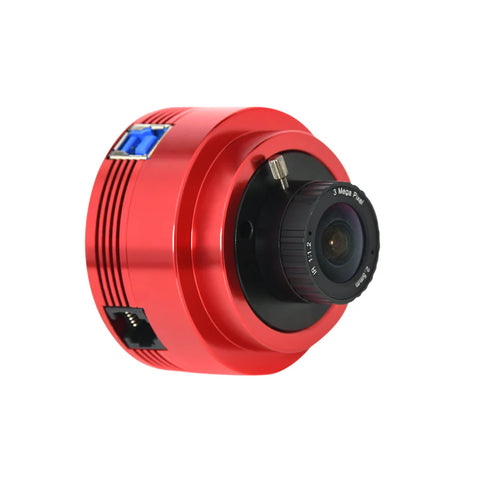
The ZWO ASI664MC is a compact color planetary camera built on Sony's 4.15MP IMX664 STARVIS 2 sensor. With 2.9µm pixels, read noise as low as 0.46e and up to 95 frames per second at full resolution, it captures the fleeting moments of steady air that turn into sharp images of Jupiter, Saturn, Mars and the Moon. It's a big step up from entry-level planetary cameras without the cost of a cooled deep-sky camera.
Key specs: Sony IMX664 color · 1/1.8" sensor · 2704 × 1536 (4.15MP) · 2.9µm pixels · 0.46e read noise · 95fps · USB 3.0 · zero amp glow
What you can capture
- Planets: Jupiter's cloud belts and Great Red Spot, Saturn's rings and the Cassini Division, and Mars's surface markings when it's close.
- The Moon: high-resolution close-ups of craters and mountain ranges, or the whole disc at shorter focal lengths.
- The Sun: sunspots and surface detail, with an approved full-aperture solar filter.
- Live viewing and guiding: zero amp glow and low noise make it a capable EAA (live-stacking) and guide camera too.
Plug in and start capturing
Thread on the included 1.25" nosepiece, slide the camera into your focuser or Barlow lens, and connect the USB 3.0 cable to your laptop. Capture software like SharpCap, FireCapture or ASIStudio records short video clips, and free stacking software turns the sharpest frames into a detailed final image. The 256MB DDR3 buffer keeps frames from dropping at full speed, and HCG mode switches on automatically at gain 252 and above for the lowest noise.

What to add for the best results
- A Barlow lens (usually needed): with 2.9µm pixels, planets look best at around f/10 to f/15. A Celestron 2x X-Cel LX or Tele Vue 3x Barlow gets most telescopes there.
- A UV/IR-cut filter: the sensor window is AR-coated, not IR-cut. A 1.25" ZWO IR-cut filter gives natural color and sharper detail.
- An atmospheric dispersion corrector: for planets low in the sky, the ZWO ADC removes the color fringing the atmosphere adds.
ASI664MC vs. ASI662MC and ASI585MC
| ASI662MC | ASI664MC | ASI585MC | |
|---|---|---|---|
| Sensor | IMX662, 1/2.8" | IMX664, 1/1.8" | IMX585, 1/1.2" |
| Resolution | 2.07MP (1920 × 1080) | 4.15MP (2704 × 1536) | 8.29MP (3840 × 2160) |
| Pixel size | 2.9µm | 2.9µm | 2.9µm |
| Max frame rate | 107.6fps | 95fps | 46.9fps |
| Read noise | 0.8–6.9e | 0.46–5.8e | 0.8–12e |
| Best for | Entry-level planetary imaging | Low-noise planetary with a wider field | Big lunar and solar fields, EAA |
Compare more options in our ZWO planetary cameras collection.
What's in the box

- ASI664MC camera body
- Cover
- 1.25" nosepiece
- ST4 guide cable
- 2m USB 3.0 cable
- Quick guide
ZWO ASI664MC FAQ
Do I need an IR-cut filter with the ASI664MC?
For natural color on planets and the Moon, yes. The ASI664MC has an AR-coated window rather than an IR-cut filter, so near-infrared light reaches the sensor and can soften detail and shift colors. A 1.25" ZWO IR-cut filter threads onto the nosepiece and fixes this. Leave it off when you want to use IR-pass or methane filters.
Do I need a Barlow lens for planetary imaging?
Usually, yes. With 2.9µm pixels, the ASI664MC works best at around f/10 to f/15 for planets. Most telescopes need a 2x to 3x Barlow to reach that, such as the Celestron 2x X-Cel LX or Tele Vue 3x Barlow, while slower scopes such as many Schmidt-Cassegrains may need less.
ASI664MC or ASI662MC?
The ASI664MC is the step up: a larger 1/1.8" sensor (vs 1/2.8"), twice the resolution and lower read noise (0.46e vs 0.8e), giving you a wider field with the same 2.9µm pixels. The ASI662MC is slightly faster (107.6fps vs 95fps) and costs less, so it suits beginners on a tight budget. For an even larger field, the ASI585MC offers 8.29MP.
Can the ASI664MC be used as a guide camera?
Yes. Its low read noise and zero amp glow make it a capable guide camera, and it connects to your mount through the built-in ST4 port or by USB with guiding software like PHD2.
What software works with it?
For capture: SharpCap (Windows), FireCapture or ZWO's free ASIStudio (Windows, Mac and Linux), or the ASIAIR's video mode. Then stack your videos in free programs like AutoStakkert! and RegiStax.
Specifications
| Sensor | |
|---|---|
| Sensor | Sony IMX664 (STARVIS 2), color |
| Sensor format | 1/1.8" (9.02mm diagonal) |
| Resolution | 4.15MP, 2704 × 1536 |
| Pixel size | 2.9µm |
| Sensor size | 7.84mm × 4.45mm |
| Shutter | Rolling |
| Peak QE | 91% |
| Full well | 36.5ke |
| Read noise | 0.46e to 5.8e |
| ADC | 12-bit |
| Performance | |
| Max frame rate | 95fps at full resolution |
| Exposure range | 32µs to 2000s |
| Buffer | 256MB DDR3 |
| Amp glow | Zero amp glow circuitry |
| Physical | |
| Interface | USB 3.0 / USB 2.0, ST4 guide port |
| Protect window | AR coated (no IR-cut) |
| Adapter | M42 × 0.75 |
| Back focus | 12.5mm |
| Dimensions / weight | 62mm diameter / 126g |
| Operating temperature | -5°C to 50°C |
| ZWO model | ASI664MC |