
Celestron
Celestron StarSense Explorer 8" Dobsonian Telescope
SKU: 22470
Yes, our inventory is accurate!
 See It In Person - On Display In Our Showroom!
 $99 Economy shipping for Dobsonian Telescopes
Due to their size and bulk, we are not able to offer free shipping on Dobsonian Telescopes, but offer a steep discount off the actual cost.
$99 Economy shipping for Dobsonian Telescopes
Due to their size and bulk, we are not able to offer free shipping on Dobsonian Telescopes, but offer a steep discount off the actual cost.
A big 8" telescope that uses your phone to show you where to look
Why we like the StarSense Explorer 8":
- The classic first "serious" telescope, made easy: an 8" Dobsonian is the size many experienced observers recommend, and the StarSense app adds on-screen arrows that guide you to each object. No star charts, no motors, no batteries in the telescope.
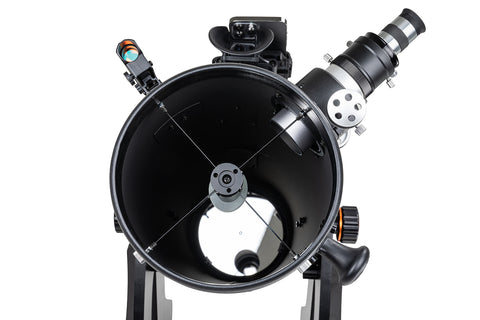
- Sharp, bright views: the 203mm parabolic mirror gathers 841 times the light of your eye, about 2.4 times as much as the StarSense DX 130AZ, enough to show Saturn's rings, Jupiter's cloud belts and dozens of galaxies.
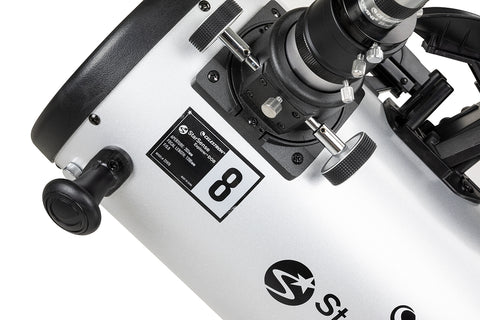
- A base that holds steady: braced side panels, large altitude bearings and adjustable altitude tension keep the tube where you point it.
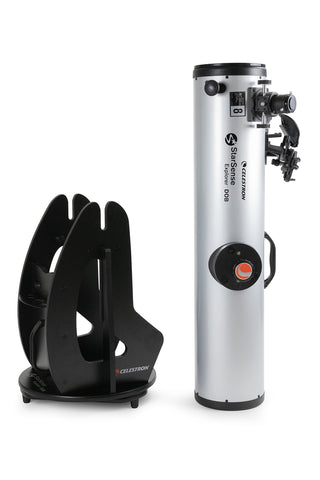
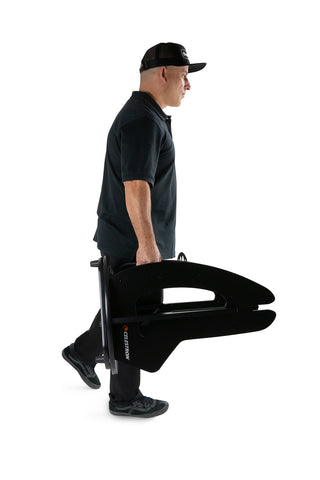
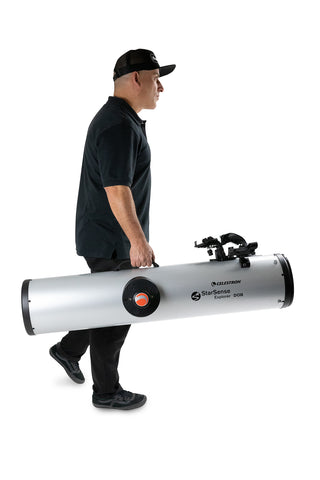
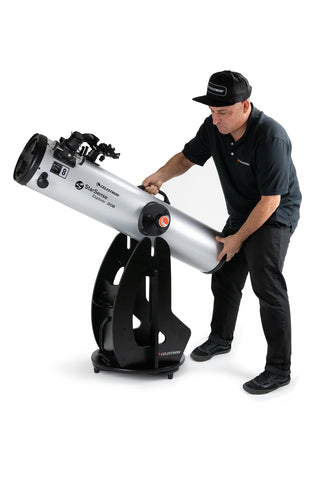
- Worth knowing: it's the lightest StarSense Dob to carry, at 20.6lb for the tube and 22.8lb for the base. Each piece has a handle, so it goes outside in two easy trips.
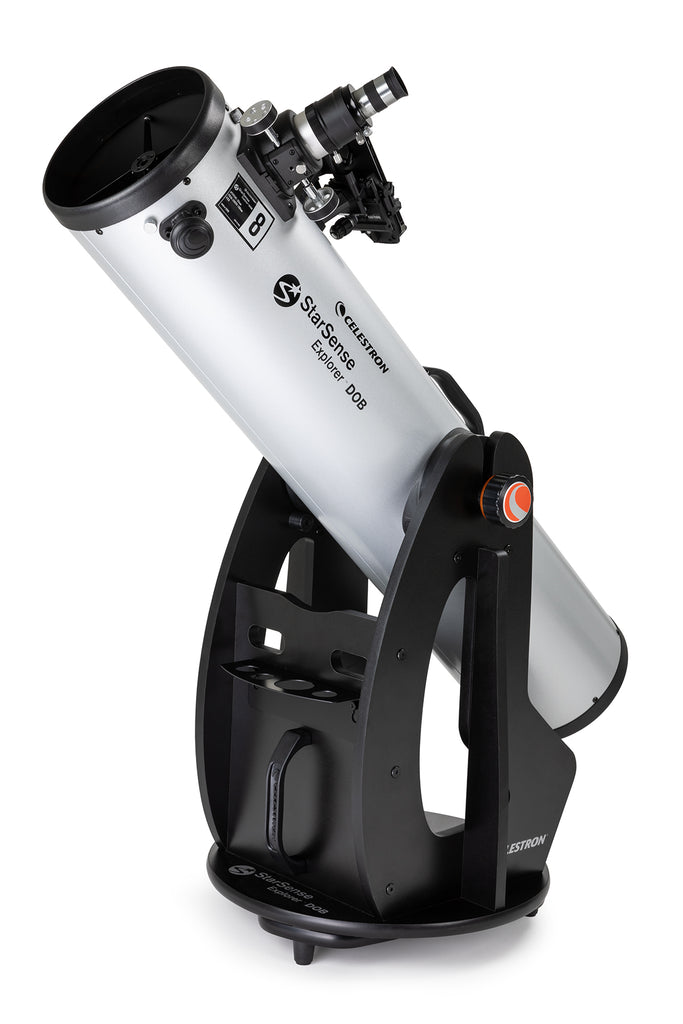
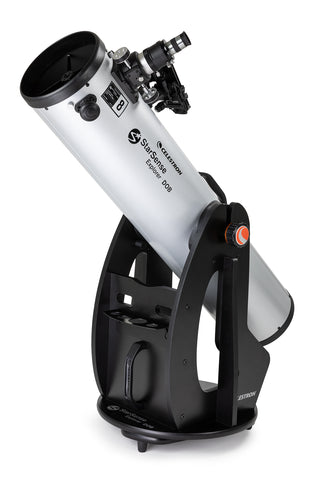
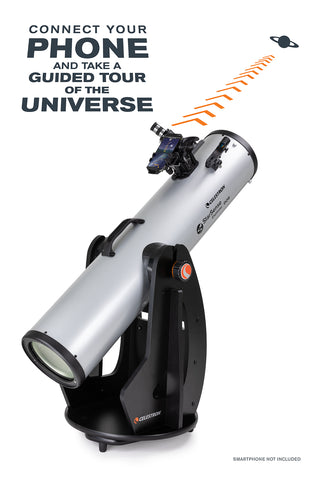
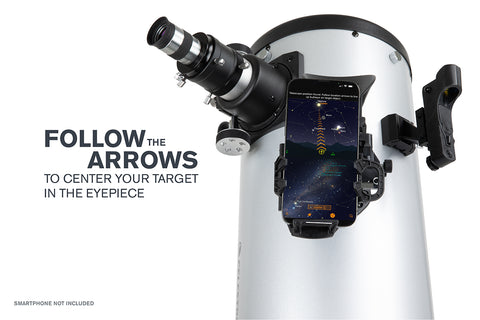
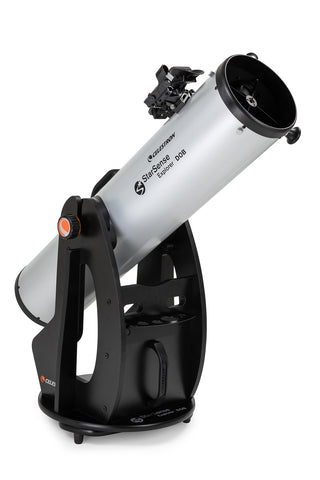
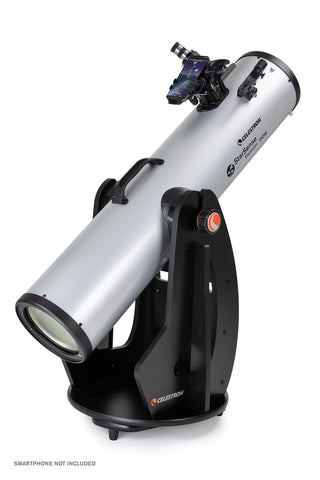
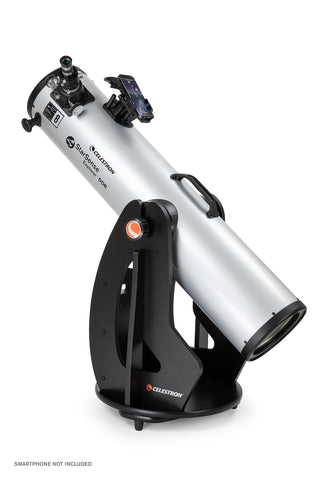
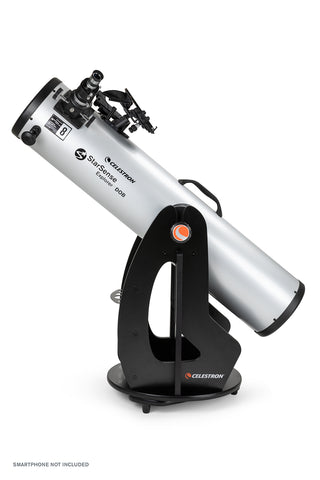
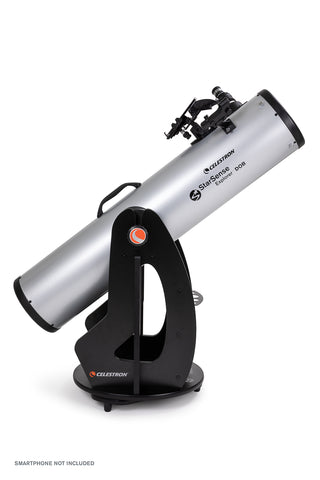
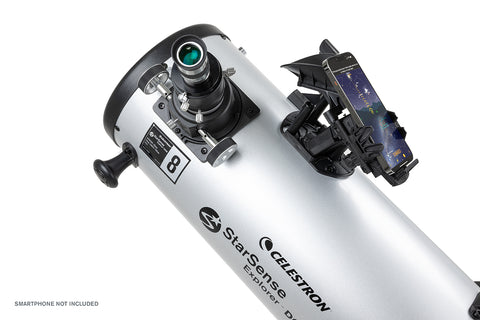
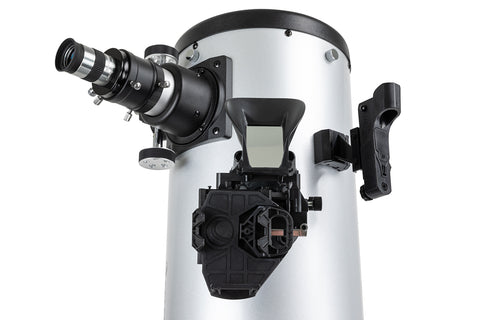
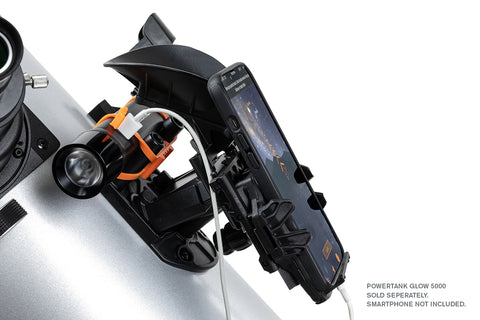
The Celestron StarSense Explorer 8" Dobsonian is a 203mm (8") Newtonian reflector on a manual Dobsonian base, with Celestron's StarSense smartphone dock. Put your phone in the dock and the StarSense Explorer app lists what's visible tonight, then shows arrows that lead you there by matching the stars your phone sees to its database. It's ideal for a beginner, a family or anyone who wants a telescope they won't outgrow, and the complete telescope weighs 43.4lb (19.7kg) in two pieces.
Key specs: 203mm (8") parabolic mirror · 1200mm focal length, f/5.9 · 25mm eyepiece (48x) · highest useful magnification 480x · 2" Crayford focuser · StarSense smartphone dock · Dobsonian base with altitude tension control · 43.4lb total
The StarSense Explorer 8" is on display in our Denver store, so you can see it in person before you buy.

What you'll see
- Planets: Saturn's rings and its moon Titan, Jupiter's cloud belts, Great Red Spot and four largest moons, the phases of Venus, and dark markings on Mars when it's close.
- Galaxies: the Andromeda Galaxy and its companions, Bode's Galaxy and the Cigar Galaxy (M81 and M82) side by side, and the Whirlpool Galaxy (M51) from a dark site.
- Nebulae: the Orion Nebula, the Ring Nebula, the Dumbbell Nebula, and the dust lane in the Lagoon Nebula.
- Star clusters and double stars: the Hercules Cluster (M13), the Double Cluster, the Pleiades, and the gold-and-blue pair Albireo.
- The Moon: craters, mountain ranges and rilles along the terminator.
How StarSense works
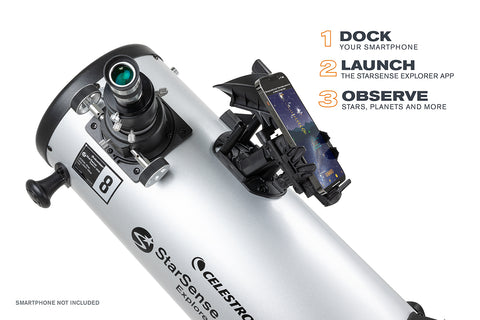
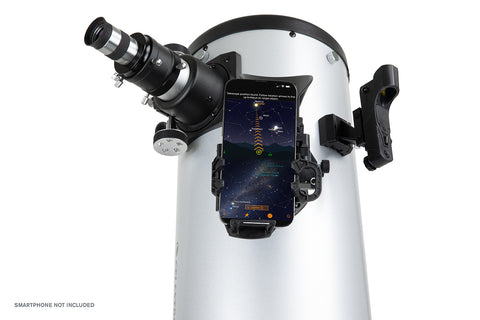
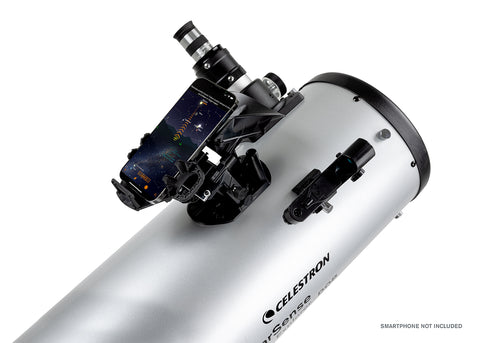
Clip your phone into the StarSense dock and do a quick one-time alignment so the phone's camera matches the telescope's view. The app reads the star patterns overhead with the same kind of "lost in space" algorithm satellites use to orient themselves, works out where the telescope is pointing and shows arrows to your target. When the bullseye turns green, the object is in the eyepiece. The app includes audio descriptions and information on thousands of objects.
Celestron lists the current app as compatible with iPhone XR or newer (iOS 18+) and Android 12 or newer. Check your phone on Celestron's compatibility page before you buy.
What to add for the best results
- Celestron X-Cel LX 9mm eyepiece: 133x, a good everyday power for planets and the Ring Nebula.
- Celestron X-Cel LX 5mm eyepiece: 240x for Saturn and Jupiter on steady nights.
- Celestron 2x X-Cel LX Barlow: doubles every eyepiece, so the included 25mm becomes 96x.
- Celestron neutral density Moon filter: cuts the glare of a bright Moon in an 8" mirror.
- Celestron PowerTank Lithium LT: keeps your phone charged through a long night of StarSense.
StarSense Explorer 8" vs. 10" and 12"
| StarSense Explorer 8" | StarSense Explorer 10" | StarSense Explorer 12" | |
|---|---|---|---|
| Aperture | 203mm (8") | 254mm (10") | 305mm (12") |
| Focal length | 1200mm, f/5.9 | 1200mm, f/4.7 | 1500mm, f/4.9 |
| Light gathering vs. the eye | 841x | 1317x | 1895x |
| Included eyepiece | 25mm (48x) | 25mm (48x) | 32mm (47x) |
| Tube weight | 20.6lb (9.3kg) | 29.2lb (13.2kg) | 49.8lb (22.6kg) |
| Total weight | 43.4lb (19.7kg) | 54.8lb (24.9kg) | 83.6lb (37.9kg) |
| Best for | The easiest to carry outside and store | The most aperture you can still move in two easy trips | Dark-site observers with room to store it |
See all Celestron StarSense Explorer telescopes and Dobsonian telescopes.
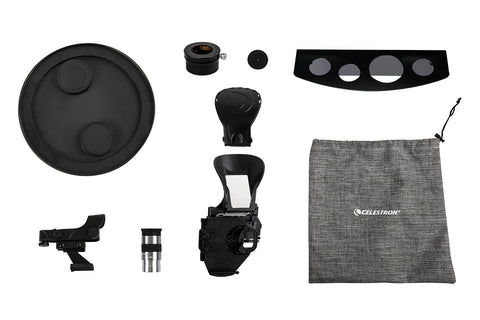
What's in the box
- 203mm (8") Newtonian optical tube with front and focuser dust covers
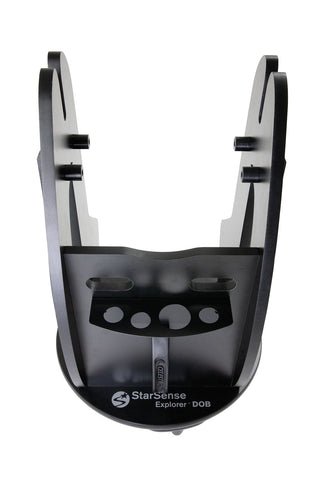
- Dobsonian base
- 25mm Plössl eyepiece (1.25")
- 2" Crayford focuser with 2" extension tube and 2" to 1.25" adapter
- StarSense Explorer smartphone dock and app unlock code
- StarPointer red-dot finderscope
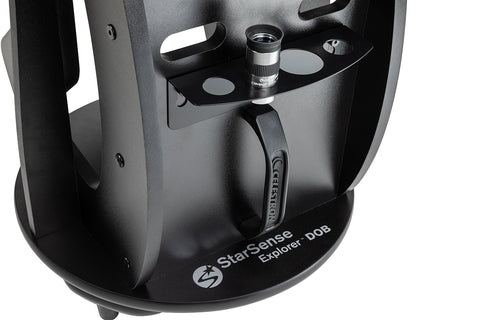
- Eyepiece rack
- Collimation cap
- Celestron Starry Night Basic Edition software

Your smartphone is not included. Extra eyepieces, a Barlow lens and filters are sold separately.
StarSense Explorer 8" FAQ
Is it good for beginners?
Yes. There are no motors or alignment steps to learn, and the app tells you where to point. It's one of the telescopes we recommend most often for a first serious telescope.
Can I see Saturn and Jupiter?
Yes. Saturn's rings are clear even at 48x with the included 25mm eyepiece, and a 9mm eyepiece (133x) shows Jupiter's cloud belts and the Great Red Spot when it's facing us.
8" or 10"?
The 10" gathers about 56% more light, which helps most on galaxies and faint nebulae. The 8" is 11.4lb lighter, shorter to store and easier for one person to carry. If you'll observe mostly from the city or a backyard, the 8" is the easier telescope to live with.
Does it need power?
No. The telescope is fully manual. Only your phone uses power, so bring a charged phone or a small USB power bank.
Will it need collimation?
Occasionally. Like any Newtonian reflector, the mirrors can shift slightly when the tube is moved. The included collimation cap lets you check and adjust them in a few minutes.
Can I use it for astrophotography?
It's built for visual observing. You can take phone photos of the Moon and planets through the eyepiece, but for deep-sky imaging you'll want a tracking mount.
Can I see one before I buy?
Yes. The StarSense Explorer 8" is on display in our Denver store.
Specifications
| Optics | |
|---|---|
| Optical design | Newtonian reflector, parabolic primary mirror |
| Aperture | 203mm (8") |
| Focal length | 1200mm (47.24") |
| Focal ratio | f/5.9 |
| Included eyepiece | 25mm Plössl (48x) |
| Highest / lowest useful magnification | 480x / 29x |
| Limiting stellar magnitude | 14.2 |
| Light gathering power | 841x the human eye |
| Resolution (Rayleigh / Dawes) | 0.68 / 0.57 arcseconds |
| Coatings | XLT reflective coatings with silicon dioxide and tantalum pentoxide overcoats |
| Mirror material | Pyrex-equivalent low-expansion glass |
| Primary mirror thickness | 25mm (0.98") |
| Secondary mirror minor axis | 47mm (1.85") |
| Focuser | 2" Crayford with 2" extension tube and 2" to 1.25" adapter |
| Finderscope | StarPointer red-dot finder |
| Base and app | |
| Mount | Manual altazimuth Dobsonian base with variable altitude tension |
| Base material | Particle board with melamine surfaces, CARB compliant |
| Smartphone app | StarSense Explorer (unlock code included) |
| Phone compatibility | iPhone XR or newer (iOS 18+); Android 12 or newer |
| Physical | |
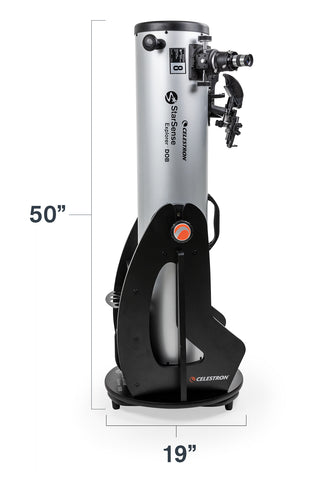
| Optical tube | 1117.6 x 241.3mm (44" x 9.5"), 9.34kg (20.6lb), steel tube |
| Base | 685.8 x 482.6 x 482.6mm (27" x 19" x 19"), 10.3kg (22.8lb) |
| Total kit weight | 19.68kg (43.4lb) |
| Warranty | 2 years (Celestron) |
| Model / SKU | Celestron 22470 |
Solar warning: never look at the Sun through this telescope or its finder without a proper solar filter covering the front of the telescope. Permanent eye damage can result.